City Of God Full Movie Download With English Subtitles
| City of God | |
|---|---|
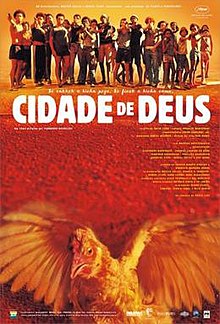 Original poster | |
| Portuguese | Cidade de Deus |
| Directed by |
|
| Written by | Bráulio Mantovani |
| Based on | City of God by Paulo Lins |
| Produced by |
|
| Starring |
|
| Cinematography | César Charlone |
| Edited by | Daniel Rezende |
| Music by |
|
| Production |
|
| Distributed by | Miramax Films[1] (through Lumière Pictures[2]) |
| Release dates |
|
| Running time | 130 minutes |
| State | Brazil |
| Language | Portuguese |
| Budget | $3.3 million[3] |
| Box function | $30.6 million[4] |
City of God (Portuguese: Cidade de Deus ) is a 2002 Brazilian crime moving-picture show co-directed by Fernando Meirelles and Kátia Lund, released in its home country in 2002 and worldwide in 2003. Bráulio Mantovani adapted the story from the 1997 novel of the same proper noun written by Paulo Lins, merely the plot is loosely based on real events. Information technology depicts the growth of organized crime in the Cidade de Deus suburb of Rio de Janeiro, betwixt the end of the 1960s and the outset of the 1980s, with the picture show's closure depicting the war between the drug dealer Li'fifty Zé and vigilante-turned-criminal Knockout Ned. The tagline is "If y'all run, the animate being catches y'all; if yous stay, the beast eats you."
The bandage includes Alexandre Rodrigues, Leandro Firmino da Hora, Phellipe Haagensen, Douglas Silva, Alice Braga, and Seu Jorge. Most of the actors were, in fact, residents of favelas such as Vidigal and the Cidade de Deus itself.
The film received widespread disquisitional acclaim and was nominated for 4 University Awards in 2004: Best Cinematography (César Charlone), Best Managing director (Meirelles), Best Film Editing (Daniel Rezende), and Best Writing (Adjusted Screenplay) (Mantovani). In 2003, information technology was Brazil'south entry for the Academy Award for All-time Strange Language Moving picture, only it did not cease up existence nominated as 1 of the five finalists. It is frequently listed by many critics and audiences every bit one of the greatest films of the 21st century and one of the best films of all time.
Meirelles and Lund went on to create the Urban center of Men TV series and film Urban center of Men (2007), which share some of the actors (notably leads Silva and Darlan Cunha) and their setting with Urban center of God.
Plot [edit]
The film begins in medias res with an armed gang chasing after an escaped chicken in a favela called the Cidade de Deus ("City of God"). The chicken stops between the gang and the narrator, a young man nicknamed Rocket ("Buscapé").
The film flashes back to the 1960s where the favela is shown as a newly built housing project with few resources. Three impoverished, amateur thieves known as the "Tender Trio" – Shaggy ("Cabeleira"), Clipper ("Alicate"), and Rocket'south older blood brother, Goose ("Marreco") – rob business owners and share the money with the customs who, in turn, hide them from the police. Li'50 Dice (Dadinho), a young male child, convinces them to hold upwardly a motel and rob its occupants.
The gang resolves non to kill anyone and tells Li'fifty Dice to serve as a sentry. Instead, Li'fifty Dice guns downwardly the motel occupants after falsely alarm the trio that the police are coming. The massacre attracts so much police attention that the trio is forced to split up: Clipper joins the Church, Shaggy is shot by the police while trying to escape the favela, and Goose is shot by Li'l Die after taking his coin while Li'l Dice's friend Benny (Bené), Shaggy's brother, watches.
In the 1970s, the favela has been transformed into an urban jungle. Rocket has joined a group of immature hippies. He enjoys photography and likes 1 girl, Angélica, just his endeavor to get close to her is ruined past a gang of lilliputian criminal kids known every bit "The Runts". Li'l Dice, who now calls himself "Li'l Zé" ("Zé Pequeno"), has established a drug empire with Benny by eliminating all of the competition, except for Carrot, who is a proficient friend of Benny'south.
Li'l Zé takes over 'the flat', a known drug distribution centre, and forces Carrot's manager Blacky ("Neguinho"), to piece of work for him instead. Coincidentally, Rocket visits the apartment to get some drugs off Blacky for Angélica during the flat raid. Through narration, Rocket momentarily considers attempting to kill Li'fifty Zé to avenge his brother but decides against information technology. He is permit go subsequently Benny tells Li'l Zé that Rocket is Goose'southward brother.
Sometime later, a relative peace comes over the City of God under the reign of Li'l Zé, who manages to avoid police attention. Benny decides to branch out of the drug dealer crowd and befriends Tiago, Angélica'south ex-boyfriend, who introduces him to his (and Rocket's) friend group. Benny and Angélica begin dating. Together, they decide to get out the City and the drug trade.
During Benny'due south farewell party, Zé and Benny get into an statement. Blacky accidentally kills Benny while trying to shoot Li'l Zé. Benny's decease leaves Li'50 Zé unchecked. Carrot kills Blacky for endangering his life. Li'l Zé and a group of his soldiers commencement to brand their fashion to Carrot's hideout to impale him.
On the way, Zé follows a daughter who dismissed his advances at Benny'due south party. He beats up her young man, a peaceful human named Knockout Ned (Mané Galinha), and rapes her. Later on Ned's brother stabs Li'l Zé, his gang retaliates by shooting into his business firm, killing his brother and uncle in the procedure. A gang war breaks out between Carrot and Li'fifty Zé. A vengeful Ned sides with Carrot.
The war is still ongoing a year afterwards, in 1981, the origin forgotten. Both sides enlist more "soldiers" and Li'l Zé gives the Runts weapons. I day, Li'l Zé has Rocket take photos of him and his gang. A reporter publishes the photos, a meaning scoop since no outsiders can safely enter the City of God anymore. Rocket believes his life is endangered, as he thinks Li'l Zé volition kill him for publishing the photo of him and his gang. The reporter takes Rocket in for the dark, and he loses his virginity to her. Unbeknownst to him, Li'fifty Zé, jealous of Ned's media fame, is pleased with the photos and with his own increased notoriety.
Rocket returns to the City for more photographs, bringing the moving picture back to its opening scene. Confronted past the gang, Rocket is surprised that Zé asks him to take pictures, but as he prepares to have the photograph, the police arrive and and so drive off when Carrot'south gang arrives. In the ensuing gunfight, Ned is killed past a male child who has infiltrated his gang to avenge his begetter, a policeman whom Ned has shot. The police force capture Li'fifty Zé and Carrot and programme to evidence Carrot off to the media. Since Li'l Zé has been bribing the law, they accept all of Li'fifty Zé's money and let him become, but Rocket secretly photographs the scene. The Runts murder Zé to avenge the Runt murdered at the bidding of Zé; they intend to run his criminal enterprise themselves.
Rocket contemplates whether to publish the cops' photo, expose corruption, and become famous, or the moving-picture show of Li'l Zé'south dead torso, which volition get him an internship at the newspaper. He decides on the latter, fearing a violent response from the cops, as well as seeing the opportunity to pursue his dream. The film ends with the Runts walking around the Urban center of God, making a hitting listing of the dealers they plan to kill to take over the drug business, including the Blood-red Brigade.
Cast [edit]
Many characters are known only by nicknames. The literal translation of these nicknames is given side by side to their original Portuguese name; the names given in English subtitles are sometimes dissimilar.
| Name | Actor(s) | Name in English language subtitles | Description |
|---|---|---|---|
| Buscapé ("Firecracker") | Alexandre Rodrigues (adult) Luis Otávio (child) | Rocket | The narrator, who dreams of becoming a photographer. His real name is Wilson Rodrigues. |
| Zé Pequeno ("Lil Zé") Dadinho ("Lil Die") | Leandro Firmino da Hora (developed) Douglas Silva (kid) | Li'l Zé Li'l Dice | A power-hungry, sociopath who takes sadistic pleasure in killing. "Dado" is a common nickname for Eduardo and means "dice", and "inho" a atomic suffix. As an adult, he is given the name Zé Pequeno in a Candomblé ceremony, which may exist unrelated to his actual proper name. Zé is a nickname for José, while pequeno ways "lilliputian". |
| Bené ("Benny") | Phellipe Haagensen (adult) Michel de Souza Gomes (child) | Benny | Zé'south longtime partner in crime, he is a friendly City of God drug dealer who fancies himself a sort of Robin Hood, and eventually wants to pb an honest life. |
| Sandro, nicknamed Cenoura ("Carrot") | Matheus Nachtergaele | Carrot | A smaller-calibration drug dealer who is friendly with Benny but is constantly threatened past Zé. |
| Mané Galinha ("Chicken Manny") | Seu Jorge | Knockout Ned | A handsome, charismatic ladies' human. Zé rapes Ned's girlfriend and then proceeds to kill several members of Ned's family. Ned joins forces with Carrot to retaliate against Zé. His name was changed for the English subtitles because in English, "craven" is a term for a coward (in Brazil information technology denotes popularity amidst women). "Mané" is a nickname for Manuel. |
| Cabeleira ("Long Hair") | Jonathan Haagensen | Shaggy | Older brother of Bené ("Benny") and the leader of the Tender Trio ("Trio Ternura"), a group of thieves who share their profits with the population of the City of God. |
| Berenice | Roberta Rodrigues | Berenice | Shaggy's Girlfriend. |
| Marreco ("Garganey") | Renato de Souza | Goose | One of the Tender Trio, and Rocket's blood brother. |
| Alicate ("Pliers") | Jefechander Suplino | Clipper | One of the Tender Trio. He subsequently gives up crime to join the Church building and is not seen for the residuum of the movie, he is the but ane of the trio who was not murdered.[5] |
| Barbantinho ("Little twine") | Edson Oliveira (adult) Emerson Gomes (kid) | Stringy | Childhood friend of Rocket. |
| Angélica | Alice Braga | Angélica | A friend and dear interest of Rocket, and later Benny's girlfriend, who motivates Benny to abandon the criminal life. |
| Tiago | Daniel Zettel | Tiago | Angélica's ex-fellow, who later becomes Li'l Zé's acquaintance and a drug addict. |
| Filé com Fritas ("Steak with Fries") | Darlan Cunha | Steak with Fries | A young boy who joins Zé's gang. |
| Charles, nicknamed Tio Sam ("Uncle Sam") | Charles Paraventi | Charles / Uncle Sam | A weapons dealer. |
| Marina Cintra | Graziella Moretto | Marina Cintra | A journalist for Jornal practice Brasil, who hires Rocket as a lensman. |
| Touro ("Bull") | Luiz Carlos Ribeiro Seixas | Touro | An honest police officer. |
| Cabeção ("Big Head") | Maurício Marques | Melonhead | A corrupt police officeholder. |
| Lampião ("Lantern") | Thiago Martins | Lampião | Child leader of the Runts gang. |
| Otávio | Marcos Junqueira | Otávio | Child leader of the Runts gang. |
Production [edit]
On the bonus DVD, it is revealed that the only professional actor with years of filming experience was Matheus Nachtergaele, who played the supporting part of Carrot.[six] Most of the remaining cast were from real-life favelas, and in some cases, even the real-life City of God favela itself. Co-ordinate to Meirelles, amateur actors were used for two reasons: the lack of bachelor professional person black actors, and the want for actuality. Meirelles explained: "Today I can open up a casting telephone call and have 500 black actors, only just ten years agone this possibility did not exist. In Brazil, there were three or four young black actors and at the same time I felt that actors from the middle form could non make the film. I needed authenticity."[7]
Start around 2000, virtually a hundred children and immature people were hand-picked and placed into an "actors' workshop" for several months. In contrast to more traditional methods (e.g. studying theatre and rehearsing), it focused on simulating authentic street state of war scenes, such as a concord-up, scuffle, and shoot-out. A lot came from improvisation, as it was thought better to create an authentic, gritty atmosphere. This manner, the inexperienced cast soon learned to move and act naturally. After filming, the crew could non leave the cast to render to their onetime lives in the favelas. Help groups were gear up up to assist those involved in the production to build more promising futures.[8] : 135–139
Meirelles went into the flick with the intention of staying true to the "casual nature" of the violence in the novel by Lins. Critic Jean Oppenheimer wrote on the production of the film maxim that: "A 2d guiding principle was to avoid glamorising the violence" and that "many of the killings are either shown indistinctly or kept out of frame."[8] : 26–32
Because the real Cidade de Deus favela was in disharmonize, a large majority of the film was shot in Cidade Alta, a dissimilar favela within Rio. During the production, slumlords did not allow for the production company to take their ain security, and then local security guards were hired for the condom of the set.[9]
Lund and Meirelles filmed the brusk moving-picture show Gold Gate every bit a test run[6] while casting for Urban center of God was in the initial stages.[10]
Reception [edit]
Box office [edit]
The movie was screened out of competition at the 2002 Cannes Moving picture Festival.[11] In Brazil, City of God garnered the largest audience for a domestic moving picture in 2003, with over three.1 million tickets sold, and a gross of R$18.6 million ($ten.3 million).[12] The pic grossed over $7.five million in the U.S. and over U.s.a.$xxx.5 one thousand thousand worldwide.[13]
Critical response [edit]
On Rotten Tomatoes, City of God has an approval rating of 91% based on reviews from 163 critics, with an boilerplate rating of 8.3/x. The website'due south consensus reads, "Urban center of God offers a shocking and disturbing—but always compelling—look at life in the slums of Rio de Janeiro."[xiv] On Metacritic, the film holds a score of 79 out of 100 based on 33 critic reviews, indicating "generally favorable reviews".[15]
Colin Kennedy from Empire awarded the film a full v out of v stars, comparing information technology favorably to Goodfellas and writing in his review, "At in one case a laboratory for movie theatre technique and a victory for raw heart, this is a snot-nosed, blood-stained masterpiece. If yous see fifty-fifty ane or two better movies this year, you will be very lucky indeed."[16] In 2008, the magazine chose City of God every bit the 177th best film of all fourth dimension.[17]
Film critic Roger Ebert awarded the film 4 stars out of 4, writing in his review, "City of God churns with furious energy as information technology plunges into the story of the slum gangs of Rio de Janeiro. Breathtaking and terrifying, urgently involved with its characters, it announces a new director of great gifts and passions: Fernando Meirelles. Think the proper noun."[18] [xix]
Filmmaker Robert Altman stated, "I don't know how Fernando Meirelles made Urban center Of God. Information technology's and so courageous, so true. I think it's the best picture I've ever seen".[20] Meirelles himself cited Altman'south work as an influence on his own career.[21]
The film was not without criticism. Peter Rainer of New York magazine stated that while the film was "powerful", it was also "rather numbing".[22] John Powers of LA Weekly wrote that "[the picture show] whirs with energy for nigh its full 130-minute running fourth dimension, it is oddly lacking in emotional heft for a work that aspires to be so epic – information technology is essentially a tarted up exploitation picture whose business organization is to make ghastly things fun".[23]
Ivana Bentes, a Brazilian picture show critic, criticised the film for its delineation of the favela and her view that it glorified issues of poverty and violence equally means of "domestication of the most radical themes of culture and Brazilian cinema ... as products for export."[24] Bentes targets the film specifically in maxim that: "Metropolis of God promotes tourism in hell".[25]
Metropolis of God was ranked No.3 in Film4's "50 Films to See Before Y'all Die", and No.vii in Empire magazine'south "The 100 Best Films of Globe Cinema" in 2010.[26] It was also ranked No.6 on The Guardian 'south listing of "the 25 All-time Action Movies E'er".[27] [28] It was ranked No.1 in Paste magazine's 50 best movies of the decade of the 2000s.[29] Time listed it every bit i of the 100 greatest films of all time.[xxx] [31]
In 2012, the Flick Editors Guild listed City of God as the 17th best-edited movie of all time based on a survey of its members.[32]
Top 10 lists [edit]
The film appeared on several American critics' top ten lists of the all-time films of 2003.[33]
- 2nd – Chicago Sun-Times (Roger Ebert) (for 2002)
- 2nd – The Charlotte Observer (Lawrence Toppman)
- 2nd – Chicago Tribune (Marc Caro)
- quaternary – New York Post (Jonathan Foreman)
- 4th – Time (Richard Corliss)
- 5th – Portland Oregonian (Shawn Levy)
- 7th – Chicago Tribune (Michael Wilmington)
- 10th – The Hollywood Reporter (Michael Rechtshaffen)
- 10th – New York Mail (Megan Lehmann)
- tenth – The New York Times (Stephen Holden)
It is ranked No.38 on the BBC list of best 100 films of the 21st century.[34]
MV Bill'due south response [edit]
Brazilian rapper MV Bill, a resident of Cidade de Deus, said the moving-picture show had "brought no good to the favela, no social, moral, or homo benefit."[35] He said, "The world will know that they exploited the image of the children who alive here in Cidade de Deus. What is obvious is that they are going to acquit a bigger stigma throughout their lives; it has only get greater because of the film."[8] : 123
Awards and nominations [edit]
Metropolis of God won l-five awards and received another 20-nine nominations. Among those:
| Organization | Honour | Recipient | Effect | Ref |
|---|---|---|---|---|
| Academy Awards | Best Managing director | Fernando Meirelles | Nominated | [36] |
| Best Adapted Screenplay | Bráulio Mantovani | Nominated | ||
| All-time Cinematography | César Charlone | Nominated | ||
| Best Film Editing | Daniel Rezende | Nominated | ||
| AFI Fest | Audience Award | Won | [37] | |
| Broadcast Movie Critics Association Awards | Best Foreign Language Film | Nominated | [38] | |
| British Academy Film Awards | Best Editing | Daniel Rezende | Won | [39] |
| Best Strange Film | Andrea Barata Ribeiro, Mauricio Andrade Ramos, Fernando Meirelles | Nominated | [40] | |
| British Independent Film Awards | Best Strange Independent Motion-picture show | Won | [41] | |
| Chicago Film Critics Association Awards | All-time Foreign Language Film | Won | [42] | |
| Golden Globe Awards | Best Foreign Language Film | Nominated | [43] | |
| Gilded Trailer Awards | All-time Independent Foreign Picture show | Won | [44] | |
| Grande Prêmio practice Cinema Brasileiro | Best Motion picture | Won | [45] | |
| Best Manager | Fernando Meirelles | Won | ||
| Best Adapted Screenplay | Bráulio Mantovani | Won | ||
| Best Cinematography | César Charlone | Won | ||
| Best Editing | Daniel Rezende | Won | ||
| Best Sound | Guilherme Ayrosa, Paulo Ricardo Nunes, Alessandro Laroca, Alejandro Quevedo, Carlos Honc, Roland Thai, Rudy Pi, Adam Sawelson | Won | ||
| All-time Actor | Leandro Firmino | Nominated | [46] | |
| Best Actress | Roberta Rodrigues | Nominated | ||
| Best Supporting Player | Jonathan Haagensen | Nominated | [47] | |
| Best Supporting Player | Douglas Silva | Nominated | ||
| Best Supporting Actress | Alice Braga | Nominated | [48] | |
| Best Supporting Actress | Graziela Moretto | Nominated | ||
| Best Art Direction | Tulé Peak | Nominated | [49] | |
| Best Costume Design | Bia Salgado, Inês Salgado | Nominated | [fifty] | |
| Best Makeup | Anna Van Steen | Nominated | [51] | |
| All-time Soundtrack | Antonio Pinto, Ed Côrtes | Nominated | [52] | |
| Independent Spirit Awards | Best Strange Language Film | Fernando Meirelles | Nominated | [53] |
| Las Vegas Motion picture Critics Guild Awards | Best Strange Language Moving-picture show | Won | [54] | |
| Motion Picture Audio Editors | All-time Audio Editing in a Strange Pic | Martín Hernández, Roland Due north. Thai, Alessandro Laroca | Won | [55] |
| New York Film Critics Circumvolve Awards | Best Foreign Linguistic communication Film | Won | [56] | |
| Prism Awards | All-time Theatrical Pic | Won | [57] | |
| Satellite Awards | All-time Foreign Language Film | Won | [58] | |
| Southeastern Film Critics Association Awards | Best Foreign Language Film | Won | [59] | |
| Toronto Film Critics Association Awards | Best Strange Linguistic communication Moving picture | Won | [lx] | |
| Toronto International Film Festival | Visions Honour – Special Citation | Won | [61] |
Music [edit]
The score to the motion picture composed by Antonio Pinto and Ed Córtes. Information technology was followed past ii remix albums. Songs from the film:
- "Alvorada" (Cartola / Carlos Cachaça / Herminio B. Carvalho) – Cartola
- "Azul Da Cor Practice Mar" (Tim Maia) – Tim Maia
- "Dance Across the Flooring" (Harry Wayne Casey / Ronald Finch) – Jimmy Bo Horne
- "Get Up (I Experience Like Being a) Sex Automobile" (James Brown / Bobby Byrd / Ronald R. Lenhoff) – James Brown
- "Hold Back the H2o" (Randy Bachman / Robin Bachman / Charles Turner) – Bachman–Turner Overdrive
- "Hot Pants Road" (Charles Bobbit / James Brownish / St Clair Jr Pinckney) – The J.B.'s
- "Kung Fu Fighting" (Carl Douglas) – Carl Douglas
- "Magrelinha" (Luiz Melodia) – Luiz Melodia
- "Metamorfose Ambulante" (Raul Seixas) – Raul Seixas
- "Na Rua, Na Chuva, Na Fazenda" (Hyldon) – Hyldon
- "Nem Vem Que Não Tem" (Carlos Imperial) – Wilson Simonal
- "O Caminho Do Bem" (Sérgio / Beto / Paulo) – Tim Maia
- "Preciso Me Encontrar" (Candeia) – Cartola
- "So Very Difficult to Get" (Emilio Castillo / Stephen M. Kupka) – Tower of Ability
Legacy [edit]
In an interview with Slant Magazine, Meirelles states he had met with Brazil'due south former president Luiz Inácio Lula da Silva who told him nearly the impact the moving-picture show has had on both policies and public security inside the country. The film has also sparked major increment in film productions, with over 45 beingness washed during 2002. Films such as The Motorcycle Diaries and The Intruder are some of the films which have used Brazil for picture product.[62]
The 2013 documentary Metropolis of God – 10 Years Later reunites the cast and crew of City of God and takes a look at how their lives have inverse after the original moving-picture show'south release. In a BBC article written at the time of the documentary's release, Firmino mentions that the bandage had mixed careers after the film's release. Firmino says that Jefechander Suplino, who played Clipper, could non be found by the documentary producers. His mother, all the same, believes him to still exist alive, only is unaware of his whereabouts. Seu Jorge, who played Knockout Ned, had a better career later the film and became a major musician, performing at the London 2012 Olympic Games closing ceremony.[63]
Effectually 40,000 people visit Rocinha (the most tourist-friendly of Rio's favelas) per twelvemonth making it the fourth most visited "allure" in Rio.[64]
See likewise [edit]
- Docufiction
- List of docufiction films
- List of hood films
References [edit]
- ^ Lyons, Charles (16 May 2002). "Miramax hails Brazilian 'God'". Diversity . Retrieved 9 September 2021.
- ^ Cajueiro, Marcelo (12 October 2007). "Lumiere relights business organization". Variety . Retrieved 9 September 2021.
- ^ Izmirlian, Pablo (4 September 2005). "From Way South of the Border, an Ecuadorean Thriller". The Washington Post. Archived from the original on two April 2015. Retrieved 3 Dec 2014.
- ^ "Urban center of God (2003)". Box Function Mojo. Archived from the original on 18 Oct 2017. Retrieved 22 July 2016.
- ^ Miramax. (2017, March three). City of God | 'Destiny' (Hard disk drive) | 2002. https://www.youtube.com/sentinel?v=UW9tYkh8Yrc
- ^ a b City of God DVD extras
- ^ Bessa, Priscila (4 June 2012). "Dez anos depois, diretor de Cidade de Deus diz ter prejuízo de R$4 milhões". Último Segundo. Internet Group. Archived from the original on 7 June 2012. Retrieved ix December 2012.
- ^ a b c Vieira, Else Ribeiro Pires (2005). Urban center of God in Several Voices: Brazilian Social Cinema as Action. Else Ribeiro Pires Vieira. Nottingham, England: Disquisitional, Cultural and Communication Press. ISBNi-905510-00-four. OCLC 62368025.
- ^ Watts, Jonathan; Vieira, Karina; Kaiser, Anna (9 June 2014). "How we made Metropolis of God". The Guardian. Archived from the original on 9 Jan 2019. Retrieved 8 Apr 2021.
- ^ Kuykendall, Niija (two May 2003). "Nosotros in Picture palace: City of God Do good". BlackFilm.com. Archived from the original on 31 December 2019. Retrieved 31 December 2019.
- ^ "Cidade de Deus". Festival de Cannes. Archived from the original on 10 October 2012. Retrieved one November 2009.
- ^ "Informe 269" (PDF) (in Portuguese). Filme B. Archived from the original (PDF) on six July 2011. Retrieved 21 April 2009.
- ^ City of God Archived 18 Oct 2017 at the Wayback Machine at Box Office Mojo.
- ^ "City of God (2002)". Rotten Tomatoes. Archived from the original on 9 March 2021. Retrieved 8 Apr 2021.
- ^ "Urban center of God Reviews". Metacritic. Archived from the original on 8 Apr 2021. Retrieved 8 April 2021.
- ^ Kennedy, Colin (1 January 2000). "City Of God Review". Empire. Bauer Media Group. Archived from the original on 8 Apr 2021. Retrieved eight April 2021.
- ^ Green, Willow (3 Oct 2008). "The 500 Greatest Movies Of All Time". Empire. Bauer Media Group. Archived from the original on 10 March 2012. Retrieved 8 Apr 2021.
- ^ Ebert, Roger (24 January 2003). "City of God (2002)". Chicago Sunday-Times. Archived from the original on 8 October 2012. Retrieved 28 April 2010.
- ^ Ebert, Roger (24 January 2003). "City of God". RogerEbert.com. Archived from the original on 12 January 2021. Retrieved 8 April 2021.
- ^ "The Total Film Interview - Robert Altman". June 2004.
- ^ "Metropolis of God - Interview with Fernando Meirelles - Nitrate Online Feature".
- ^ Rainer, Peter (eight January 2003). "Gangs of Rio". New York. Archived from the original on 22 September 2020. Retrieved 8 Apr 2021.
- ^ Powers, John (16 January 2003). "Straight Outta Ipanema". LA Weekly. Archived from the original on eight April 2021. Retrieved 8 Apr 2021.
- ^ Bentes, Ivana (2003). Nagib, Lúcia (ed.). The New Brazilian Cinema. London: I.B. Tauris. pp. 121–136. ISBNi-4175-1979-7. OCLC 55808559.
- ^ Freire-Medeiros, Bianca (nine May 2011). "'I went to the City of God': Gringos, guns and the touristic favela". Journal of Latin American Cultural Studies. xx (1): 25. doi:10.1080/13569325.2011.562631. ISSN 1356-9325. S2CID 194097832.
- ^ Green, Willow (23 September 2019). "The 100 Best Films Of World Movie theater". Empire. Archived from the original on 25 Dec 2020. Retrieved viii April 2021.
- ^ Fox, Killian (xix Oct 2010). "Metropolis of God: No 6 best activeness movie and war film of all time". The Guardian. London. Archived from the original on iii October 2020. Retrieved 8 Apr 2021.
- ^ "The 25 best action and state of war films of all time: the full listing". The Guardian. 19 October 2010. Archived from the original on vii May 2016. Retrieved 8 April 2021.
- ^ "The l Best Movies of the Decade (2000-2009)". Paste. iii November 2009. Archived from the original on 13 May 2020. Retrieved viii Apr 2021.
- ^ "Metropolis of God – All-Fourth dimension 100 movies". Fourth dimension. 12 February 2005. Archived from the original on 25 May 2005. Retrieved 8 January 2014.
- ^ Corliss, Richard (13 January 2010). "All-Time 100 Movies - City of God". Time. Archived from the original on 22 March 2021. Retrieved eight April 2021.
- ^ "The 75 All-time Edited Films". Editors Guild Magazine. 1 (3). May 2012. Archived from the original on 17 March 2015. Retrieved 25 April 2017.
- ^ "Metacritic: 2003 Film Critic Top X Lists". Metacritic. Archived from the original on 25 Dec 2007. Retrieved v January 2008.
- ^ "The 21st Century's 100 greatest films". BBC. 23 August 2016. Archived from the original on 24 Nov 2016. Retrieved 4 May 2017.
- ^ Setti, Ana (nine February 2003). "REALIDADE E FICÇÃO Cidade de Deus sofre com o estigma da violência". Folha de Londrina (in Portuguese). Archived from the original on 23 February 2020. Retrieved 23 February 2020.
- ^ Grey, Tim (27 Jan 2004). "A wing-ding for 'The Male monarch'". Variety. Archived from the original on 4 March 2016. Retrieved xiii Feb 2015.
- ^ Berkshire, Geoff (eighteen November 2002). "'Shoujyo' nabs AFI jury prize". Variety. Archived from the original on thirteen February 2015. Retrieved xiii February 2015.
- ^ Hirsch, Lisa (nine March 2003). "Handicapping Oscar". Diverseness. Archived from the original on 4 March 2016. Retrieved xiii February 2015.
- ^ Dawtrey, Adam (23 Feb 2003). "High notes for 'Pianist'". Variety. Archived from the original on 28 October 2018. Retrieved 13 February 2015.
- ^ "Kudos count". Variety. fifteen February 2004. Archived from the original on 28 October 2018. Retrieved 13 Feb 2015.
- ^ Dawtrey, Adam (4 November 2003). "'Dirty' sweeps BIFAs". Diverseness. Archived from the original on 4 March 2016. Retrieved 13 Feb 2015.
- ^ Rooney, David (21 January 2004). "'Rex' reigns among Chi crix". Diversity. Archived from the original on iv March 2016. Retrieved 13 February 2015.
- ^ Gray, Tim (19 December 2002). "Miramax & 'Chi' fly high". Variety. Archived from the original on 4 March 2016. Retrieved 13 February 2015.
- ^ Berkshire, Geoff (26 May 2004). "'Stepford' steps off with best-trailer trophy". Variety. Archived from the original on 5 March 2016. Retrieved 13 February 2015.
- ^ "Academia Brasileira de Movie theater divulga lista dos melhores de 2002". Folha de S.Paulo (in Portuguese). Grupo Folha. 17 Dec 2003. Archived from the original on 16 Feb 2015. Retrieved xvi February 2015 – via Universo Online.
- ^ ""Oscar brasileiro" anuncia finalistas". O Estado de S. Paulo (in Portuguese). Grupo Estado. 3 November 2003. Archived from the original on 16 Feb 2015. Retrieved 16 February 2015.
- ^ "Finalistas 2003: Melhor Ator Coadjuvante" (in Portuguese). Academia Brasileira de Cinema. Archived from the original on sixteen February 2015. Retrieved xvi Feb 2015.
- ^ "Finalistas 2003: Melhor Atriz Coadjuvante" (in Portuguese). Academia Brasileira de Cinema. Archived from the original on 16 February 2015. Retrieved sixteen February 2015.
- ^ "Finalistas 2003: Melhor Direção de Arte" (in Portuguese). Academia Brasileira de Picture palace. Archived from the original on xvi February 2015. Retrieved sixteen February 2015.
- ^ "Finalistas 2003: Melhor Figurino" (in Portuguese). Academia Brasileira de Movie theater. Archived from the original on 16 Feb 2015. Retrieved 16 February 2015.
- ^ "Finalistas 2003: Melhor Maquiagem" (in Portuguese). Academia Brasileira de Cinema. Archived from the original on 16 Feb 2015. Retrieved sixteen Feb 2015.
- ^ "Finalistas 2003: Melhor Trilha Sonora" (in Portuguese). Academia Brasileira de Picture palace. Archived from the original on 16 February 2015. Retrieved xvi February 2015.
- ^ Susman, Gary (3 December 2003). "Here are the Independent Spirit Accolade nominees". Entertainment Weekly. Archived from the original on 13 February 2015. Retrieved 13 Feb 2015.
- ^ Grimm, Bob (8 January 2004). "Las Vegas Picture show Critics Society 2003 Winners". News & Review . Retrieved 13 February 2015.
- ^ Kamzan, Josh (three March 2004). "Pic 'Masters' audio kudos". Diversity. Archived from the original on 4 March 2016. Retrieved thirteen February 2015.
- ^ Rooney, David (fifteen Dec 2003). "Gotham crix crown 'Rex' as best film". Diversity. Archived from the original on 5 March 2016. Retrieved 13 February 2015.
- ^ "Prism Awards accolade actors for portrayals". Deseret News. ane May 2004. Archived from the original on 22 September 2018. Retrieved 13 Feb 2015.
- ^ Maldonado, Ryan (17 December 2003). "Satellites pix picked". Diversity. Archived from the original on 22 April 2016. Retrieved 13 February 2015.
- ^ "The Critics' Choice". Amusement Weekly. nine Jan 2004. Archived from the original on 13 February 2015. Retrieved xiii Feb 2015.
- ^ Kelly, Brendan (17 December 2003). "Toronto crix speak up for 'Translation'". Multifariousness. Archived from the original on four March 2016. Retrieved thirteen February 2015.
- ^ Tillson, Tamsen (15 September 2002). "A 'Whale' of a tale in Toronto". Diverseness. Archived from the original on 4 March 2016. Retrieved xiii Feb 2015.
- ^ Gonzalez, Ed (27 August 2003). "Interview: Fernando Meirelles Talks City of God". Slant Mag. Archived from the original on 23 June 2020. Retrieved 15 February 2019.
- ^ Bowater, Donna (half-dozen Baronial 2013). "Metropolis of God, 10 years on". BBC News. Archived from the original on xiii January 2019. Retrieved 15 February 2019.
- ^ Cheded, Farah (17 January 2018). "The Legacy of 'City of God' on Brazil's Favelas". Moving-picture show School Rejects. Archived from the original on 16 February 2019. Retrieved xv Feb 2019.
External links [edit]
- Official website (in Portuguese)
- City of God at IMDb
- City of God at AllMovie
- City of God at Box Office Mojo
- City of God at Rotten Tomatoes
- City of God at Metacritic
DOWNLOAD HERE
Posted by: morelvold1951.blogspot.com


0 Comments